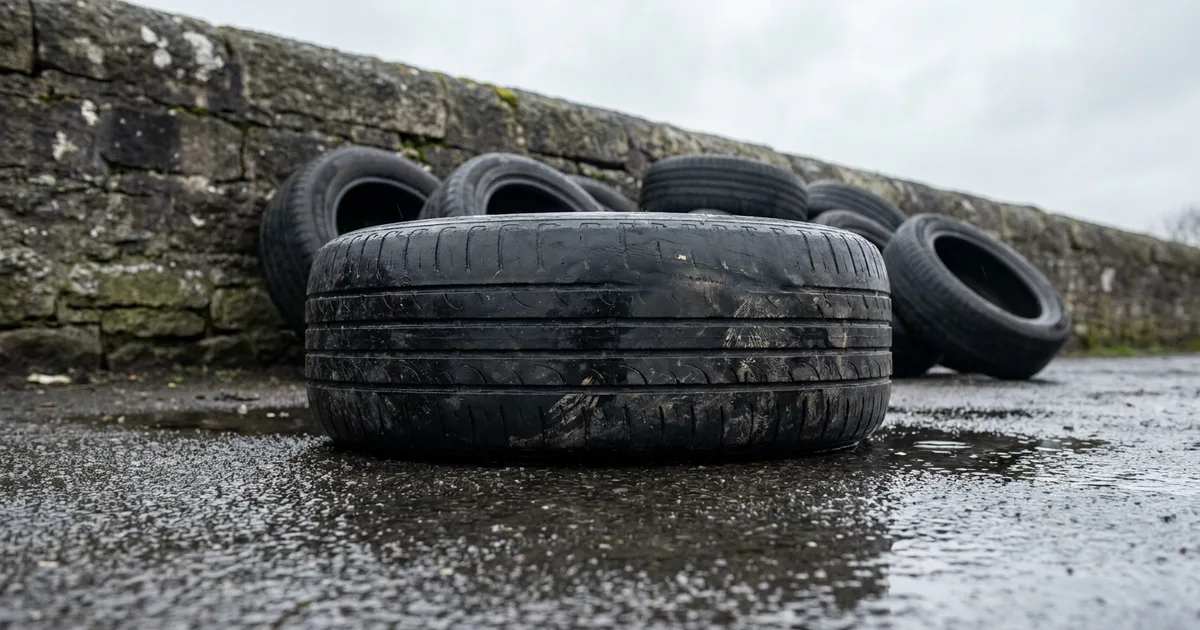
There is a line people reach for when part-worn tyres come up: you wouldn't buy a used parachute, so why would you buy a used tyre?
It is a good line. It is also, strictly speaking, wrong. Skydivers buy used parachutes all the time. There is a healthy second-hand market in canopies, containers and full rigs, and plenty of experienced jumpers have never owned a new one.
But look at what has to happen before a skydiver will jump one, and the comparison gets far more damning than the original line ever was.
What a skydiver demands before buying used
Nobody in that sport buys a canopy off a stranger and jumps it on Saturday. Before money changes hands, the buyer wants the serial number, the date of manufacture, the number of jumps on it, whether it has been relined and when, what conditions it has been jumped in, and any history of damage or repair. Then they pay a qualified rigger to inspect it before the sale completes. That inspection is treated as the cost of doing business, not an optional extra.
On top of that, the reserve is on a legal clock. Under British Skydiving rules, a reserve parachute has to be repacked every six months by a suitably qualified rigger, whether it has been used or not. Every pack is recorded. The kit carries its own paper trail, and that trail is what makes the second-hand market safe enough to exist.
So the honest version of the saying is not "you wouldn't buy a used parachute". It is this: you would only ever buy a used parachute because it comes with a logbook and a rigger's signature.
Now ask what comes with a part-worn tyre.
Nothing comes with a part-worn tyre
No jump count. No service history. No named inspector. In most cases the seller cannot tell you what car it came off, how it was driven, whether it spent two years underinflated, or whether it has been down a kerb at forty.
That matters more than it sounds, because a tyre is not a lump of rubber. TyreSafe describes it as an engineered product built from around thirty different components, and the ones that fail are almost all on the inside. Running a tyre underinflated cooks the internal structure. A pothole or a kerb strike can break cords without leaving a mark you can see. The damage that ends up killing people is, by its nature, the damage you cannot look at.
Part-worn tyres are not required to be x-rayed for internal defects before sale. So when a seller tells you a tyre is fine, what they are really telling you is that it looks fine from the outside. That is fit and hope.
They are legal, and that is the confusing bit
Part-worn tyres are perfectly legal to buy and sell in the UK. It is the conditions attached that almost nobody meets.
Under the Motor Vehicle Tyres (Safety) Regulations 1994, a part-worn tyre cannot be sold unless:
The structural integrity is intact, with no large cuts, no bulges or lumps inside or out, and no exposed plies or cords. It has passed an inflation test before sale. The original tread grooves are still clearly visible in their entirety, at least 2mm deep across the full breadth of the tread and around the whole circumference. And the words PART-WORN are permanently and legibly applied next to the approval mark, in upper case letters at least 4mm high, not hot-branded and not cut into the rubber.
That last one is the easy test, and it is the one to remember. If a tyre is being sold to you as part-worn and it does not carry the words PART-WORN moulded or bonded onto the sidewall, the sale is already illegal, and you are being sold it by someone who either does not know the rules or is ignoring them. Neither is a person you want choosing what goes between your car and the A90.
What the inspections actually found
This is not a theoretical concern. TyreSafe has been buying part-worn tyres and inspecting them alongside Trading Standards for years, and the numbers are consistently grim.
Of 278 part-worn retailers investigated, 261 were found to be non-compliant. That is 93%. Some 94% of the tyres inspected were being sold illegally. More than 63% were judged unsafe to go back on the road at all. Almost a quarter, 22%, were ten years old or older. Around 18% had been repaired incorrectly. The oldest tyre turned up in those investigations was 29 years old.
In one exercise, TyreSafe bought fifty part-worn tyres. Exactly one of the fifty was sold legally, correctly marked and inspected. Among the rest they found sub-standard repairs, exposed cords, damaged beads, clear evidence of running underinflated, and one tyre with a piece of metal sticking roughly 5cm out through the tread.
Where they come from
There is one detail that explains a lot about the trade. Germany's legal minimum tread depth is 3mm. Ours is 1.6mm.
So a tyre that has reached the end of its legal life in Germany still has well over the UK limit left on it. It gets pulled off, containered across, and sold here as a bargain. Others come off scrapped, written-off or dismantled vehicles, which means the last thing that happened to some of them was a crash.
The money argument does not survive either
Most people buying part-worns are not being reckless. They are being skint, which is a different thing entirely and a lot more sympathetic. The problem is that the sums do not work.
Stop comparing the price of the tyre and start comparing the price per millimetre of tread you actually get to use. A new tyre typically arrives with around 8mm. You are legally required to change it at 1.6mm. So you have bought roughly 6.4mm of usable tread.
A part-worn can legally be sold at 2mm. Buy at the legal floor and you have bought 0.4mm of usable tread. You will be back for another set within months, paying again, and paying for the fitting again.
And the miles you do get are the worst miles the tyre has. The British Tyre Manufacturers' Association measured wet braking from 50mph and found a tyre at 1.6mm of tread needs almost 12 metres more to stop than a new one. That is around three car lengths, and it is the gap between a near miss and an insurance claim. On a wet December morning on the A9, or coming off a roundabout in Dundee, three car lengths is everything.
Worth knowing too: driving on a tyre below 1.6mm risks a fine of up to £2,500 and three penalty points, per tyre. A part-worn bought at 2mm does not leave you much road before that becomes your problem rather than the seller's.
What we do instead
The Tyre Soldier fits new tyres only. Not because new is a nicer word, but because a new tyre is the only one that arrives with a known history and a full set of tread.
That does not mean expensive. We source any make and size same-day through local trade suppliers, and that covers every budget from value to premium. A budget new tyre from a reputable manufacturer, correctly fitted and balanced, is a genuinely cheap tyre. It is also the honest version of the thing a part-worn is pretending to be.
We come to you, wherever you are, across Dundee, Tayside, Perthshire and Fife, at home, at work or at the roadside, including out of hours. If you want to talk it through before committing, our mobile tyre fitting page sets out how it works, and we will always tell you if a tyre can be repaired rather than replaced.
Back to the parachute
The skydiver buying second-hand is not taking a gamble. They are buying a documented item, inspected by a qualified person, on a mandatory service cycle, with its whole life written down.
Take all of that away and no skydiver on earth would jump it. That is the deal on offer at a part-worn tyre shop, and it is being offered for the one component that holds your family to the road.